Medlea
日本語 ▾
SCIENCE · METHOD AND EVIDENCE

From the whole lung to every airway

How the functional twin is built from a CT, how it breathes, the benchmarks it is held to and the studies built on it. Written for the engineers and scientists who will ask.

The whole lung

Lobes, parenchyma and a breath, from one CT

From the same routine chest CT, AI segments the five lobes, the trachea and the bronchial tree, case by case. A model of lung mechanics, coupled to a fast surrogate of the airway flow, then makes the reconstructed lung breathe: how much air each lobe takes in, where the lung inflates and where it over-distends, and a simulated forced expiration.

  • Five lobes, trachea and bronchial tree segmented automatically from the CT
  • Regional ventilation per lobe, mapped on the familiar CT slices
  • Virtual spirometry: simulated FEV1 and FVC per lobe (research use only)
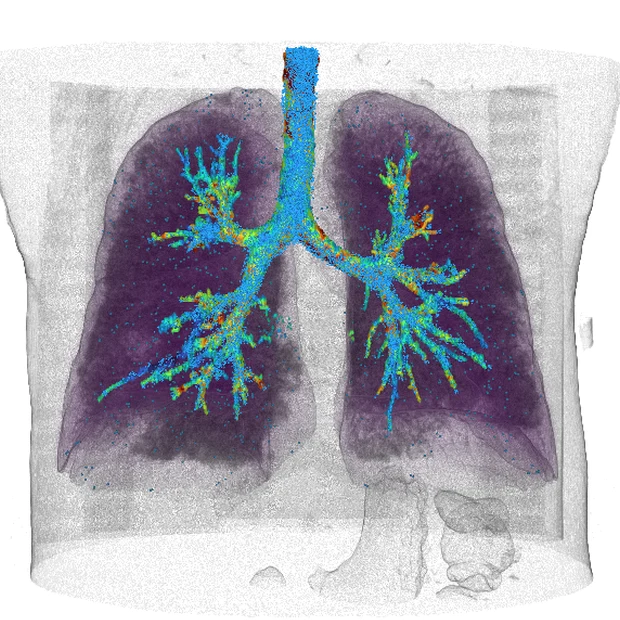
Both lungs and the airway tree reconstructed from a chest CT, during a simulated breath. Demo case.

Airways

Airflow in every airway: lattice Boltzmann on GPU

The airway surface is segmented from a routine chest CT and placed automatically on the regular Cartesian grid of a lattice-Boltzmann solver. There is no volume mesh to build: an AI agent proposes inlet and outlets, sets the flow conditions and runs the case.

  • Lattice-Boltzmann flow solver, running on GPUs, in the cloud or on premises
  • Surface from the CT made watertight and voxelised onto the solver grid automatically
  • The same agentic pipeline for one patient or a whole cohort

Validation of the flow

Held to the SimInhale benchmark

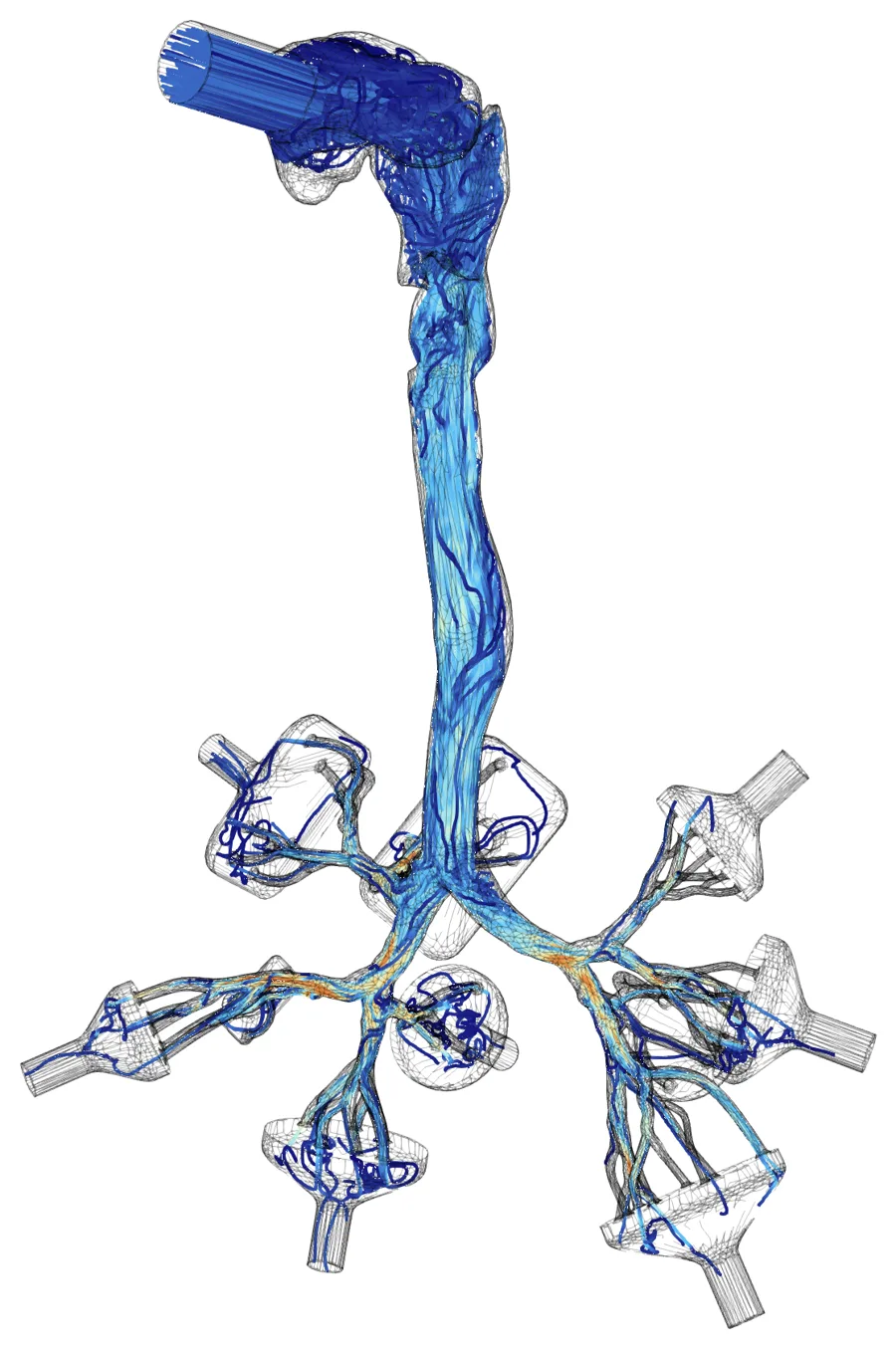
SimInhale is a public airway geometry with measured flow data, used by the inhalation community to compare simulation codes. We run the same geometry and conditions and compare against the measurements.

  • Measured velocity profiles reproduced
  • Flow split between the main bronchi reproduced
  • Results in an internal manuscript, not yet peer reviewed
Streamlines in the SimInhale benchmark geometry.

Particles

Inhaled aerosol, from the mouth to the deep lung

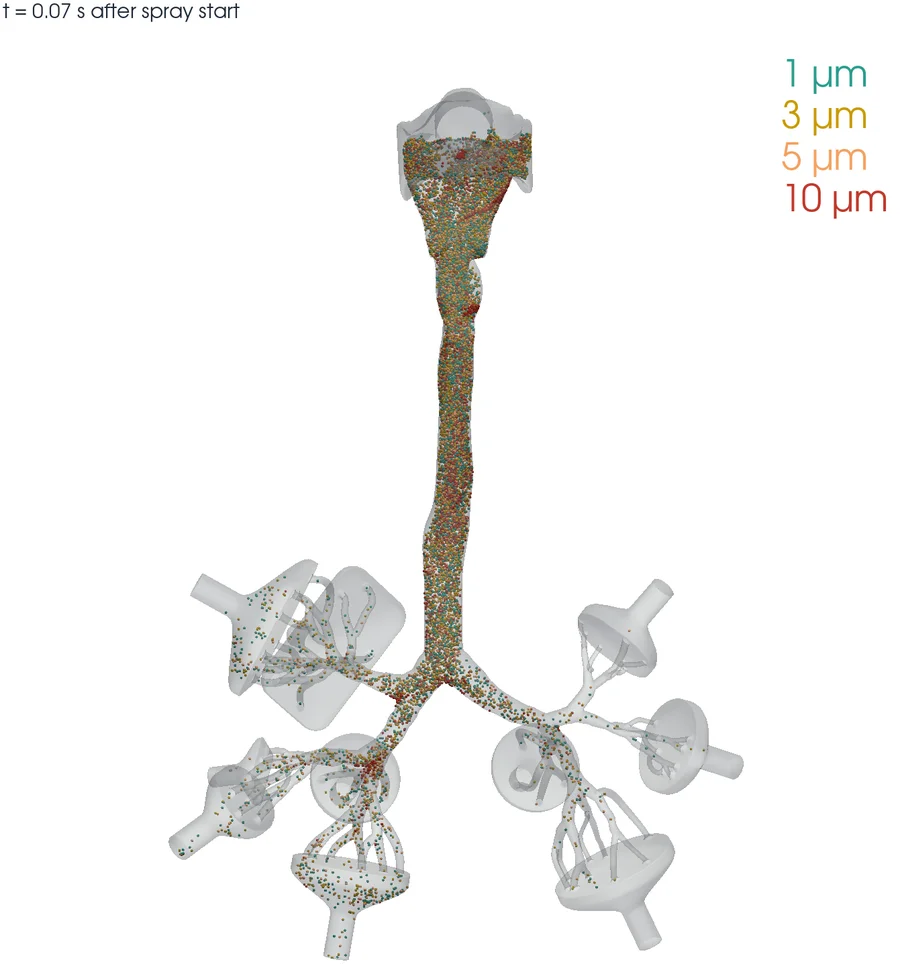
Particles from inhaler, nebuliser and spacer presets are released at the mouth and carried by the computed flow. Our development solver records where each particle meets the airway wall, and the regional deposition has been compared with the SimInhale in-vitro measurements for particles from 1 to 10 µm.

  • Inhaler, nebuliser and spacer presets
  • Several particle sizes in the same simulation
  • Deposition compared region by region with in-vitro data
Inhaled particles of 1 to 10 µm carried by the airflow in the SimInhale benchmark airway. Lattice-Boltzmann simulation, preliminary.

Performance and traceability

Fast enough for cohorts, and every run on record

Cohort studies only make sense if each case is quick and each result can be traced. The wall treatment of the solver was rewritten for GPUs, and every attested run carries a signed record of the software, hardware and data that produced it, built with EQTY Lab.

  • Simulation step with wall surfels 43 times faster on GPU than the previous version of our solver (internal benchmark)
  • 43 patient airways at two flow rates in about one day on a GPU cluster (see Pharma & devices)
  • Signed provenance record for every attested run
  • Results exported as VTU; geometries as STL, OBJ, PLY or VTP

Publications

Papers

  • Submitted

    Manuscript on the lattice-Boltzmann solver, submitted to MDPI Computation (special issue), 2026.

  • In preparation

    Agentic airway flow simulation at population scale: the 43-patient cohort study.

Ask us about the method

If you want the details behind a figure on this page, or to test the method on your own geometry, write to us.

Contact us

LeaFlow is a research and engineering tool and is not part of the CE-marked LeaRes medical device. Nothing on this page describes a clinical use on individual patients.