
Your department chooses the pattern. The platform builds the model.
Imaging AI usually arrives with its diseases already chosen. This platform is built the other way round: the hospital defines the pattern it cares about, annotates its own cases, and the model is trained inside its own perimeter.
A mixture-of-experts architecture: each expert is a narrow model for one pattern, and a light orchestrator combines their outputs into regional measurements. What we build is not a fixed set of experts — it is the machinery that produces one.
The loop that produces the model
The model proposes, the radiologist corrects, and the corrections become the next dataset. Every pass is meant to leave less to correct in the one after.
-
Pre-annotation
a public backbone on the first pass, your own model after that
-
Correction
the radiologist decides — this is where clinical judgement lives
-
Frozen dataset
immutable and fingerprinted, so a model traces back to its cases
-
Fine-tuning
on the hospital's own GPU, from the backbone, never from scratch
-
Model and evaluation
held-out test set, scored per site
the improved model returns as the next pre-annotation
We don't sell a model. We sell the machine that makes one.
A model trained on a fixed list of diseases needs data most centres cannot share, and it is the part of the field that commoditises fastest. We take the opposite route: the platform is the product, and each hospital uses it to build a model on its own cases.
- ● The pattern is described by clinicians in clinical language — it is not a parameter an engineer picks.
- ● Nothing in the architecture assumes which pathology you are looking for.
- ● The resulting model belongs to the centre whose data produced it.

What an expert is made of
Onboarding a new pattern is not a fresh research project each time. An expert is a fixed set of parts, named before any training starts: a pattern definition, an annotation protocol, a dataset specification, a starting backbone, a training recipe, an evaluation harness and a provenance record.
- ● Fine-tuning from a pre-trained backbone, never from scratch — tens of annotated cases rather than the thousands a ground-up model would need.
- ● Without an evaluation harness a model is not an expert but an experiment, so the harness is specified up front rather than assembled afterwards.
Add an expert without disturbing the others
Each expert produces its own map, and a small orchestrator combines them into regional figures — volumes and fractions per pattern and per lobe. Adding a pattern adds an expert; it does not mean retraining what is already there.
- ● Patterns that co-occur are handled by passing spatial distribution to the orchestrator, not only aggregate volumes.
- ● The orchestrator's inputs stay inspectable, so a clinician can see which patterns drove a figure.
The data never leaves the hospital
Annotation, training and inference all run inside the hospital's own perimeter, on its own GPU. No patient data is transferred to us, and no weights are pooled between sites.
- ● Built for jurisdictions where health information cannot cross a border.
- ● Every site starts from the same public backbone and trains alone, so no site is exposed to another's data.
- ● Frozen datasets, trained models and their provenance records stay with the centre.

What we measure, and what we don't
The number we report is the time it takes a radiologist to correct a case, and how that time behaves as more cases are annotated. It measures annotation efficiency, not diagnostic accuracy, and the distinction is deliberate.
- ● The output is a set of measurements: volumes and fractions per pattern and per lobe, with a confidence score.
- ● It is not a disease label, and it is not intended to make or replace a clinical decision.
- ● Evaluation is per site and against a held-out test set — a model trained at one centre is never scored inside another's aggregate.
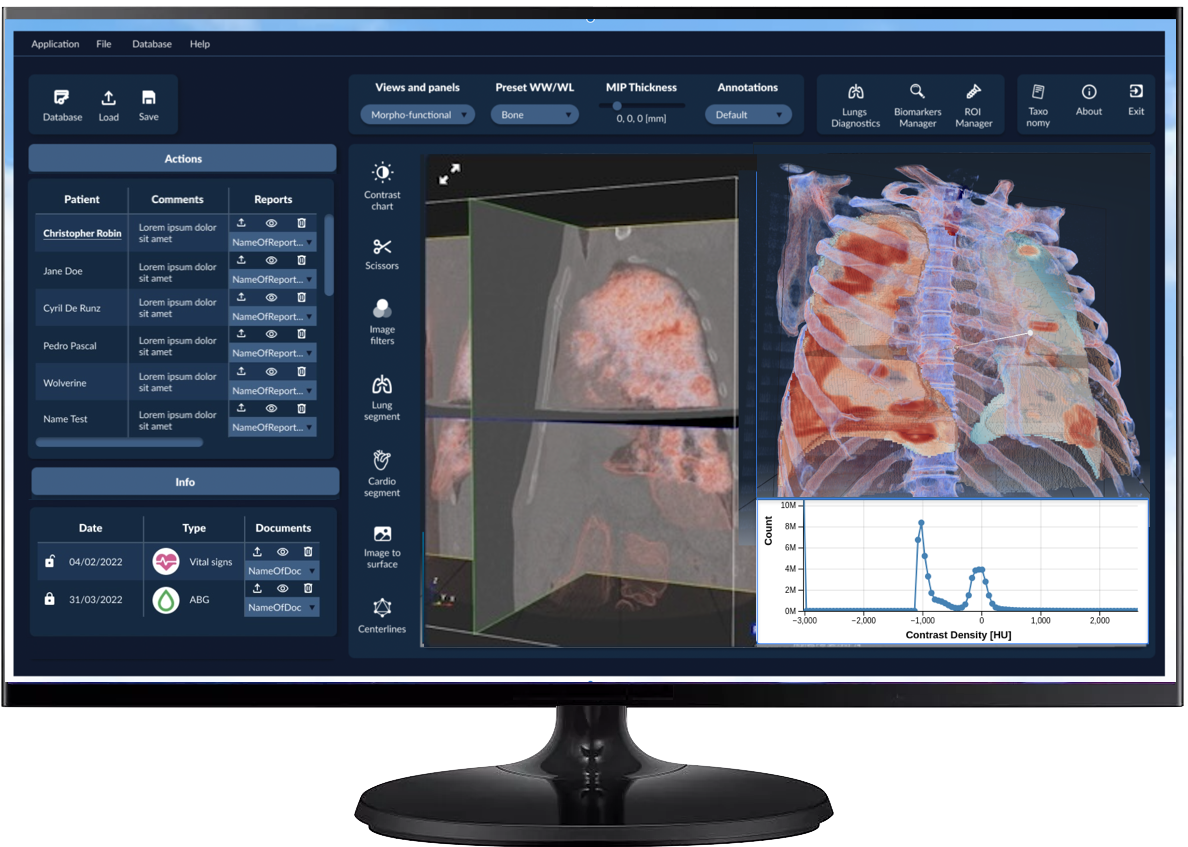
Anatomy, not diagnosis. The platform quantifies structures and patterns that a clinician has defined; it does not produce a diagnosis and is not a substitute for clinical judgement. Work with clinical centres is at pilot stage.
Bring your own pathology
We are setting up the first pilot sites. If your centre has a pattern it needs quantified and the cases to annotate, we would like to hear about it.
Talk to us →