
The lung,
simulated breathing.
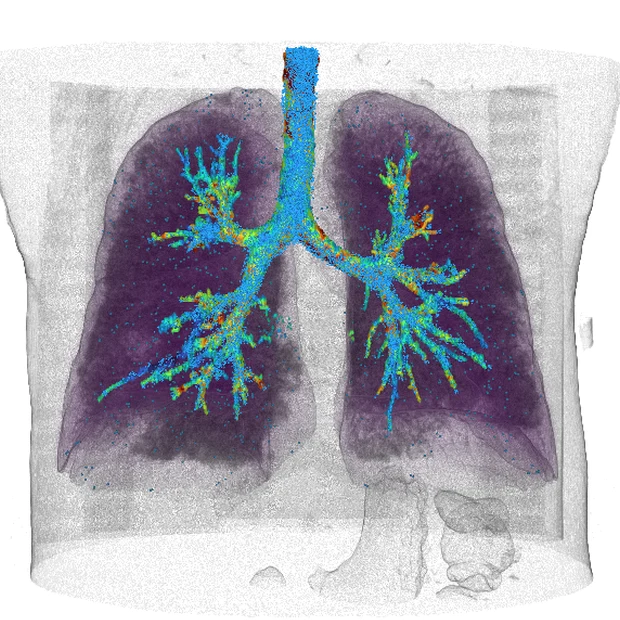
Medlea turns a chest CT into a functional digital twin. AI rebuilds the patient’s lungs; a physics engine on GPU makes them breathe. Airflow, ventilation and spirometry, computed on their own anatomy.
- Agentic AI workflow
- GPU multiphysics
- Patient-specific CFD
- Confidential computing
- FEV1
- 3.20 L
- FVC
- 4.38 L
- FEV1/FVC
- 72.9 %
- Engineering-grade physics
The simulation methods used to design aircraft and engines, computed on the patient’s own airways, not inferred from a population.
- Measurements, not labels
Every number on screen belongs to this anatomy, this scan, this breath. Clinical judgement stays with the clinician.
- Inside the hospital
Reconstruction, training and simulation run on your GPU, in the cloud or on premises.
Clinical and research partners


Programmes, funders and investors



Clinical question, engineering answer
Imaging shows the shape. The twin shows the breath.
From a routine chest CT to a lung that breathes, in three automated steps.
- 01 · Agentic AI
From the scan
AI segments the lobes and the airway tree from the CT, case by case.
- 02 · Physics on GPU
To the breath
A lattice-Boltzmann flow solver makes the reconstructed lung breathe: airflow in every airway, ventilation in every region.
- 03 · Simulated measurements
To the numbers
Spirometry per lobe, airway resistance, ventilated volume: measurements no scan shows on its own, comparable over time.
One engine, three ways in
LeaRes
The functional twin at work: lung anatomy, regional ventilation and virtual spirometry, in the browser.
Explore LeaRes →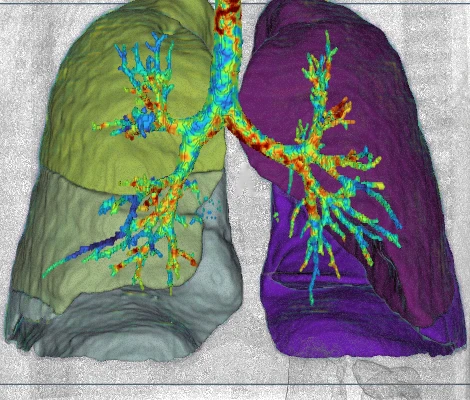
Platform
Your department names the pattern, annotates its own cases, and the model is trained inside your perimeter. The product is the machine that makes a model.
Explore the platform →- 1Your team defines the pattern
- 2Clinicians annotate
- 3Training on your GPU
- 4The model proposes, you correct
LeaFlow
Patient-specific simulation across whole cohorts, run by an agentic pipeline. First application: airflow and aerosol transport in the airways.
Explore LeaFlow for industry →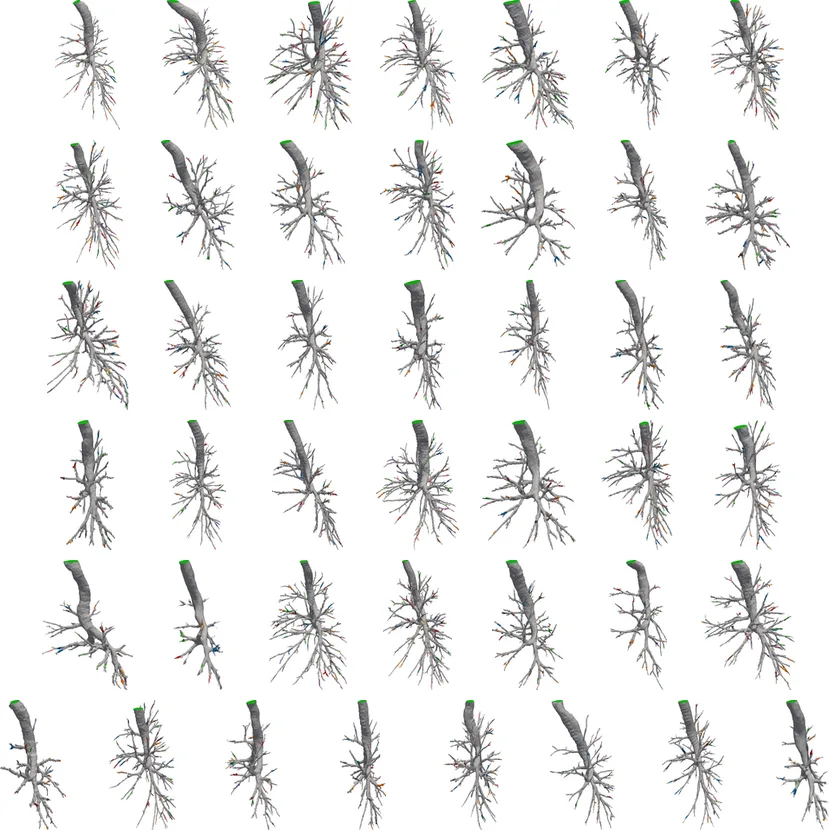
Evidence your Data Protection Officer can verify
Every virtual-spirometry run can leave a signed record of what went in, what ran and what came out: the software, the hardware it ran on, and the data it touched. Built with EQTY Lab, so your team can verify it independently.

- Software The exact pipeline version, fingerprinted and signed.
- Hardware Confidential-computing evidence from the machine that ran it.
- Data Input and output fingerprints. No patient data in the record.
Who it is for
Critical care
Study how ventilation distributes in the patient’s own lung model, for research and training.
Use cases →Thoracic surgery
Study how much each lobe contributes to the breath, on the patient’s own anatomy.
Use cases →Research & pharma
In-silico studies of airflow and aerosol transport in real airways, across patient cohorts.
Pharma & devices →Device makers
Study inhalers, nebulisers, tubes and valves in real airway anatomy, across patient cohorts.
Pharma & devices →See a lung breathe on a case like yours
A walkthrough with our team, on a demo case or on your own data inside your perimeter.