Medlea
LEAFLOW · FOR PHARMA AND DEVICE MAKERS

Your drug or device,
across real patients.

LeaFlow turns clinical scans into patient-specific simulations, and an agentic pipeline runs them across whole cohorts instead of one idealised model. The first application, validated and running today, is airflow and aerosol transport in the airways.

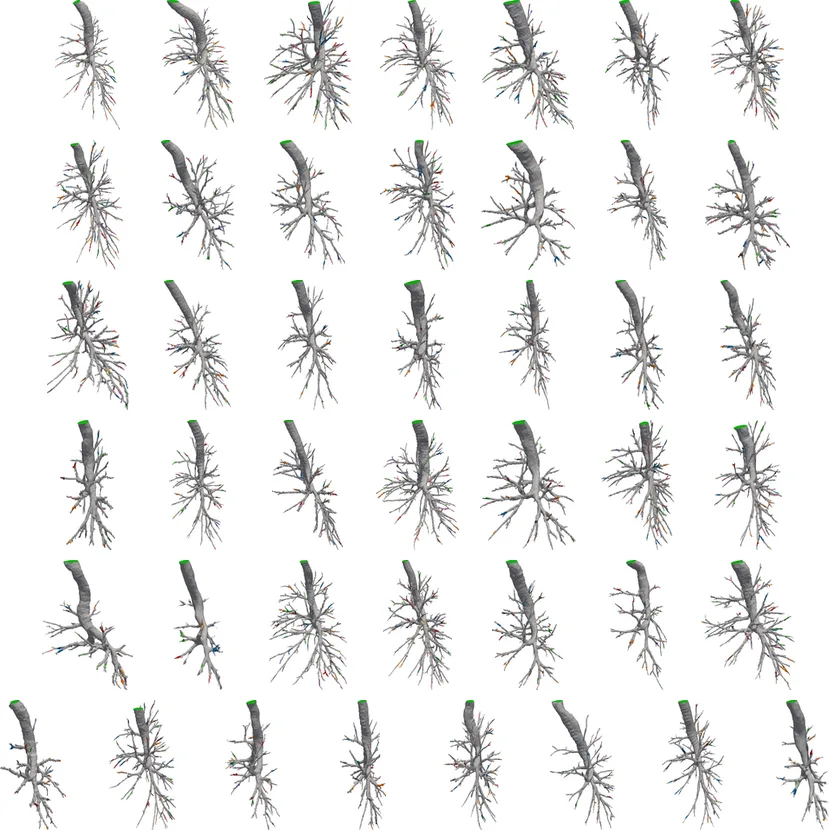
The 43 reconstructed airway trees of the internal cohort study.

Why it matters

Populations, not averages

01

Anatomy varies more than models assume

An idealised model is one geometry. Real patients differ in calibre, branching and angle, and those differences change the flow a drug or a device works in. Our cohort showed a thirty-fold spread where a single model shows one number.

02

New propellants for inhalers

The move of pressurised inhalers to low-global-warming propellants changes the spray. Each reformulation raises the same question: does the drug still reach the same airways?

03

Physical tests are slow and few

Casts and in-vitro rigs cover a handful of geometries. Simulation can cover dozens before a prototype is built, and points the physical tests to the cases that matter.

Agentic, at cohort scale

43 patient airways, two flow rates, about one day

An AI agent carries each case from the CT to the result without manual meshing: segmentation, geometry, set-up on a regular lattice-Boltzmann grid, simulation and report. In our internal study the unmodified pipeline ran 43 airway trees from routine clinical CT, at resting and exertional flow, in roughly one day on a GPU cluster.

43
airway trees from routine clinical CT
2
flow rates per case, resting and exertional
≈ 1 day
for the whole cohort, on a GPU cluster
30×
spread in mid-airway turbulent energy across patients

Internal study, manuscript in preparation; not yet peer reviewed.

Who it is for

Three ways in

Inhaled drug developers

Compare formulations and devices on the same set of real anatomies.

  • Airflow and aerosol transport in each patient’s airways
  • Cohorts that reflect the variability of your target population
  • Results you can reproduce and trace, run by run

Inhaler and nebuliser makers

Place the device in front of a reconstructed airway and test design variants.

  • Presets for pressurised and dry-powder inhalers, nebulisers and spacers
  • Device geometry imported from CAD
  • Nebulisers inside a ventilation circuit

Airway device makers

Stents, tubes and endobronchial valves in the anatomy they are designed for.

  • Flow before and after a device, in the same patient
  • Geometry out as STL, OBJ, PLY or VTP; results as VTU
  • Engineering workflow in the browser, on your GPU or ours

Where we are

What works today, and what we are building

Today

  • Airflow in patient airways

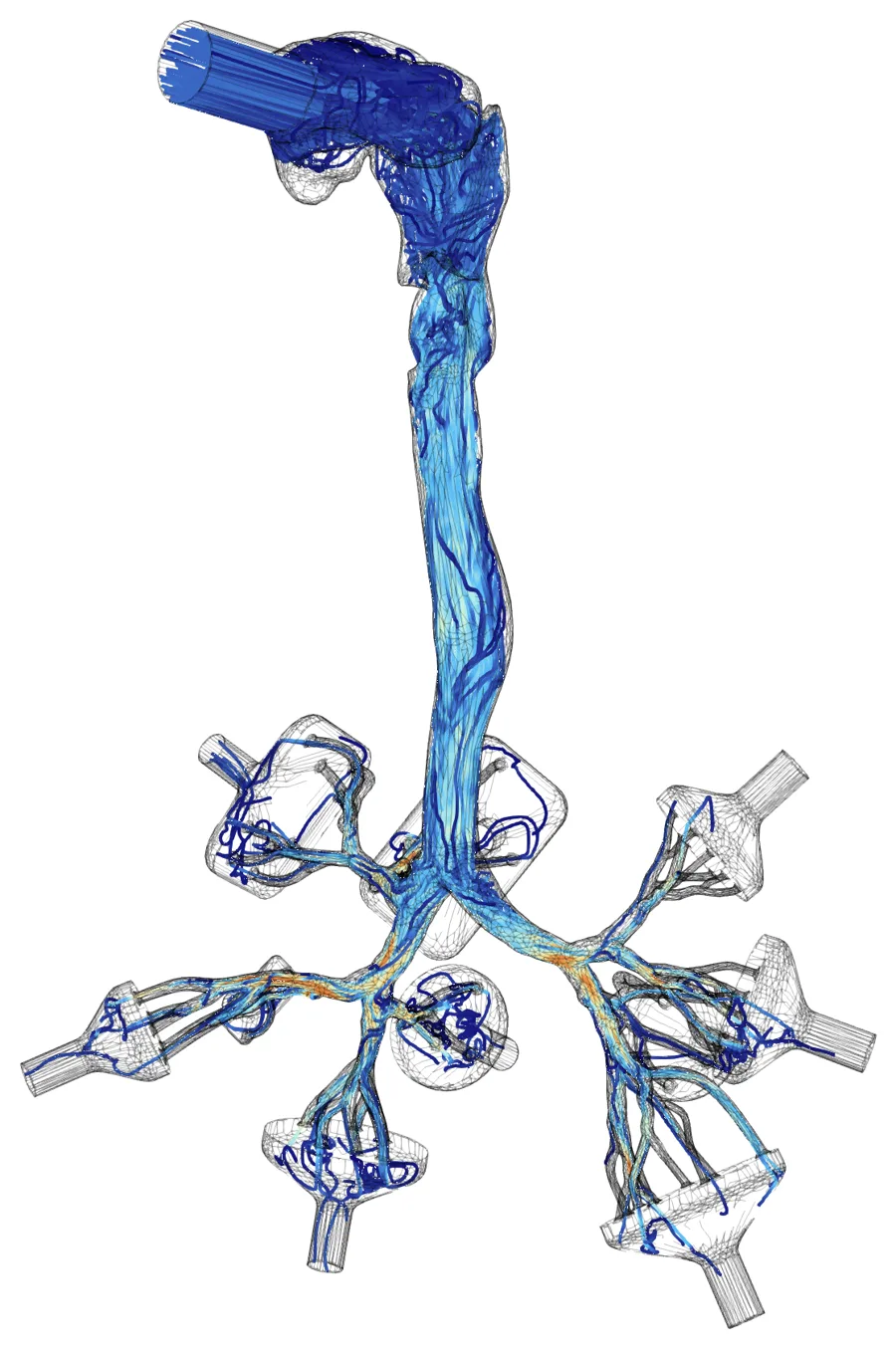
    Lattice-Boltzmann solver on GPU, validated against the SimInhale benchmark: measured velocity profiles and the flow split among the main bronchi.

  • No manual meshing

    The airway surface from the CT is voxelised automatically onto the solver grid; inlet and outlets are proposed by the platform.

  • Aerosol injection and transport

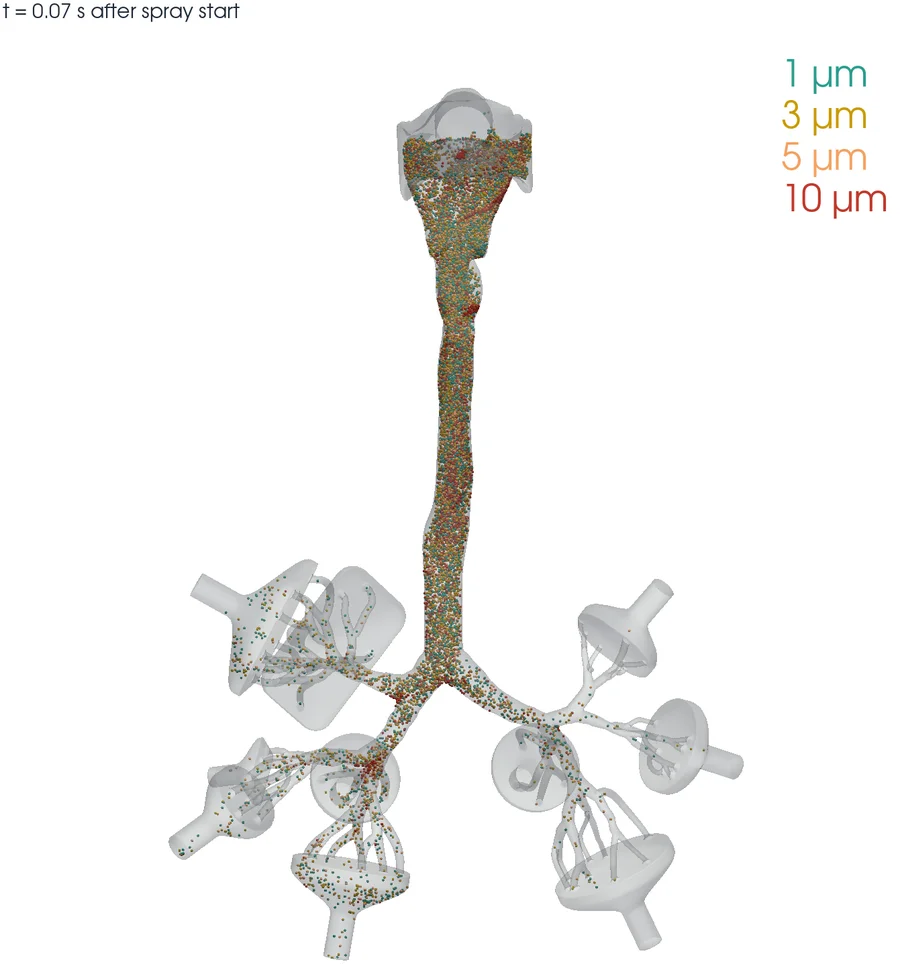
    Inhaler, nebuliser and spacer presets emit particles that the flow carries through the airways.

  • Traceable runs

    Each attested run carries a signed record of software, hardware and data, built with EQTY Lab.

  • Particle deposition on the airway wall

    The solver records where each particle touches the airway wall, with identical results on CPU and GPU. Validation against the SimInhale deposition data is under way, then the same 43-patient cohort; we would like to do this with industry partners.

  • Several particle sizes

    Particles from 1 to 10 µm in the same simulation, each followed through the airways.

  • Beyond the airways

    The same engine and pipeline on vessels and other anatomies, as research and development.

Inhaled particles of 1 to 10 µm carried by the airflow in the SimInhale benchmark airway. Lattice-Boltzmann simulation, preliminary.
Streamlines in the SimInhale benchmark geometry, the reference used to validate the flow.

How to work with us

Start small, on your question

  1. 1

    Pilot study

    One device or formulation question, a defined set of anatomies, a written report. Weeks, not months.

  2. 2

    Co-development

    Build and validate regional deposition together, with your in-vitro or clinical data as the reference.

  3. 3

    Engineering licence

    Run LeaFlow yourself, in the cloud or on your own GPUs, with the same agentic pipeline.

Bring us a drug or device question

Tell us the product, the formulation or the patient population you care about. We will propose a pilot on real anatomies.

Contact us

LeaFlow is a research and engineering tool. It is not part of the CE-marked LeaRes medical device and it is not intended for clinical decisions on individual patients.